



While Africa’s wildebeest migration is always a draw for safari travellers, the rains in April and May make this a less popular time to travel. Those in the know get to enjoy the Serengeti at its most beautiful and photogenic, with dramatic skies and opportunities to view resident wildlife as well as the herds.

The rains of April and May prompt the herds to move through Tanzania’s central Serengeti, motivated by the green flush that spreads across the savannah. The herds – greatly increased by the recently born calves – move north en masse.
While the classic mental image is an endless sea of waving grass, the terrain in the central Serengeti is very diverse. The distinctive granite outcrops, rocky hills and shallow river valleys host significant populations of resident wildlife.
For the local predators, this is a time of plenty. The calves, many only a few weeks old, are particularly tempting targets. This makes for some spectacular cat-and-calf sightings as antelope desperately twist and turn to safety or destiny.
-
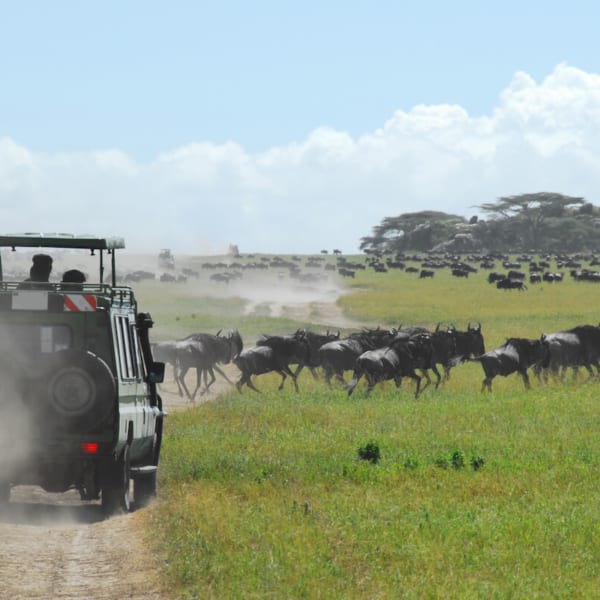 In April and May, those in the know get to enjoy the Serengeti at its most beautiful and photogenic.
 -
 The rains of April and May prompt Africa's wildebeest migration to move through Tanzania’s central Serengeti.
 -
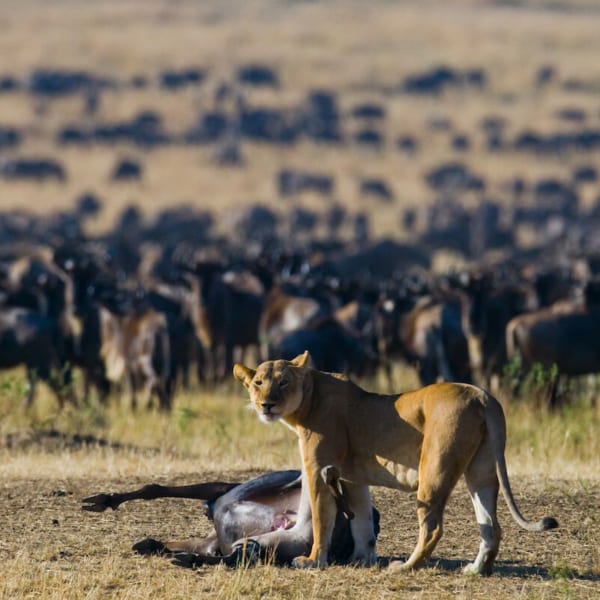 For the local predators, April and May is a time of plenty.
 -
 Witnessing Africa's wildebeest migration cross the savannah en masse is phenomenal.


The notion of the rainy season deters some travellers, who then miss out on spectacular cloud formations, and capturing incredible images of Africa’s wildebeest migration against gunmetal grey skies and vivid greenery. Tanzania‘s safari lodges and camps have greater availability, with shoulder season rates offering exceptional value.
Safari activities are rarely interrupted by the short, sharp afternoon showers. Electric storms, writ large across the sky, are reflected in the crackling energy on the ground – the pent-up wanderlust of the herds and the sudden bursts of aggression from the big cats.
Although Africa’s wildebeest migration is one, long continuous loop (albeit with endless variations), it’s not a case of perpetual motion. The herds pause from time to time to rest and feed, before the urge to move on again becomes irresistible.
During these times, the plains are dotted with knots of antelope, herds in microcosm that pulse and swell as they assemble prior to moving on again. At times, the herd seems like one giant organism.
Between the bruised skies and drama, a safari to the central Serengeti makes for an unforgettable experience. Each day becomes a cascade of breathtaking moments, from close escapes to conflict over kills.
-
 An aerial view of Africa's wildebeest migration is quite something.
 -
 Africa's wildebeest migration offers a cascade of breathtaking moments, from close escapes to conflict over kills.
 -
 Safari lodges and mobile camps offer abundant luxury during Africa's wildebeest migration. © Serengeti Migration Camp
 -
 There are brief moments of calm in the midst of the swirling sea of life that is Arica's wildebeest migration. © Sanctuary Kichakani Serengeti Camp


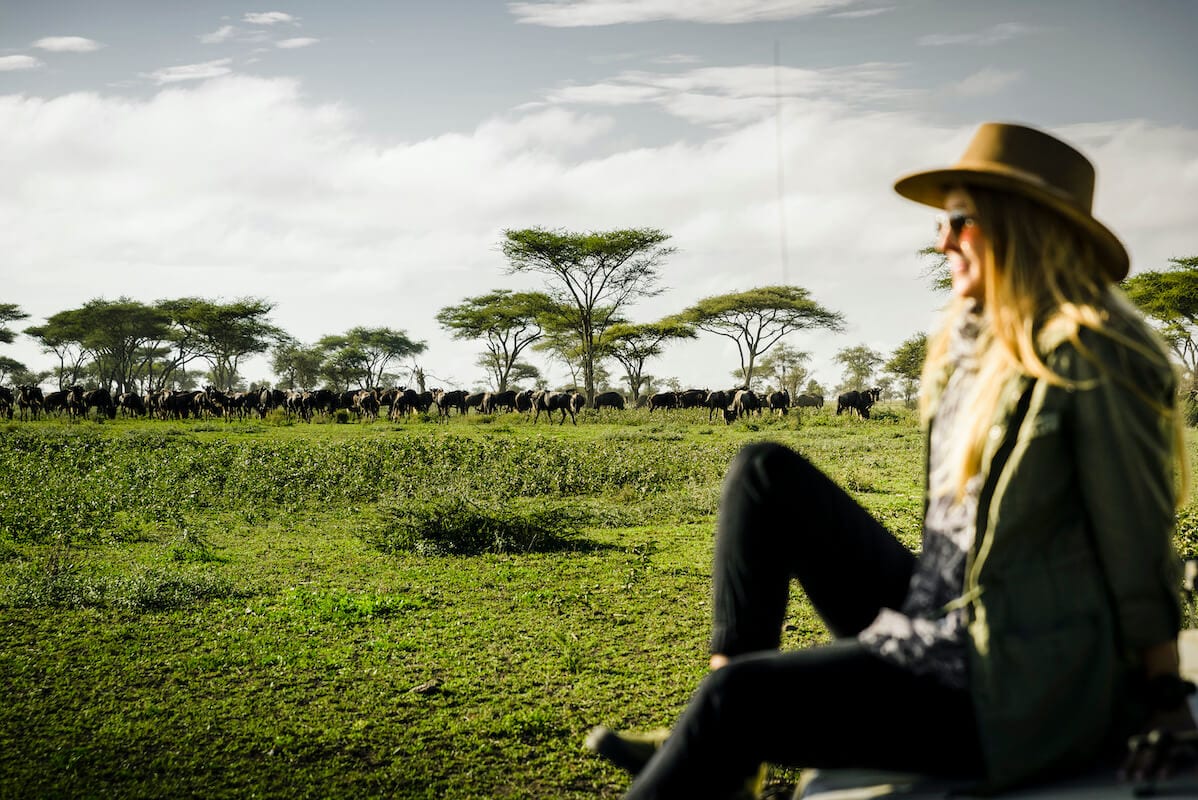
There are also brief moments of calm in the midst of this swirling sea of life, with sunbeams picking out a lone animal that’s become separated from its group, or perhaps a resident solitary creature gazing in some puzzlement at the sudden influx.
Safari lodges and mobile camps offer abundant luxury, but the weather often adds adventure to the proceedings. Sudden downpours can instantly turn the black cotton soil into a morass – but it’s nothing that the local guides haven’t seen before. At worst, getting stuck means a chance to stretch legs and pose for selfies.
The same rains that transform the Serengeti lay a temporary carpet of purple and yellow blooms across the floor of the Ngorongoro Crater, giving a once-yearly chance to witness elephant and rare black rhino fording a shallow lake of flowers.


